

That’s the million-dollar question in edge-cloud systems! CLEVER Project is tackling it with a blend of engineering smarts and intelligent orchestration.
📢 Our new research which was presented at CLOSER 2025, shows how to deploy microservice-based apps more efficiently by dynamically adjusting the processing speed (frequency) of each computing core across the edge-cloud continuum using a technique called DVFS.
What is DVFS?
Dynamic Voltage and Frequency Scaling is like cruise control for CPUs, it increases speed when needed and lowers it to save energy. By tuning each CPU core’s frequency based on what it’s doing, you can strike a balance between speed and sustainability.
💡 But here’s the twist:
Apps aren’t just a single task. They’re graphs of smaller services working together. Some of those services are critical and time-sensitive; others can wait a bit.
⚙️ CLEVER’s approach:
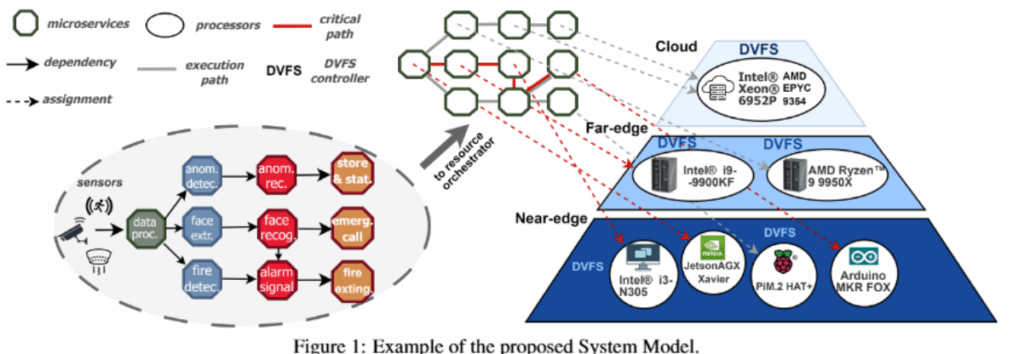
- Models the app as a DAG (Directed Acyclic Graph) to find the “critical path” (the slowest link in the chain)
- Uses genetic algorithms to explore millions of hardware configurations
- Matches each microservice with the best CPU and frequency across edge, fog, and cloud layers
- Uses a second heuristic algorithm to smartly deploy everything in real infrastructure
The Results?
🔻 Energy savings: Cuts energy use by up to 31.5% versus traditional high-performance deployments.
🚀 Faster than Greedy Policies: Our approach reduces execution time by 3.2% compared to performance-focused baselines. Better than greedy “performance-first” or “energy-first” approaches.
📉 Adaptive Trade-offs: Tuning a single weight (*w*) lets operators prioritize speed, efficiency, or balance.
Below is a snapshot showing how CLEVER proposed a system model:
🔗 Explore how we’re building smarter, greener digital infrastructures:
https://www.cleverproject.eu
🌐 Check out the Zenodo paper for more information: https://zenodo.org/records/15601569
